The AI Security Blind Spot in Front-End Development Enterprises Keep Missing

Your enterprise probably has robust data protection policies. Encryption at rest, encryption in transit, access controls, and audit logs. Years of security investment protecting sensitive information.
None of it applies the moment someone pastes client data into an AI prompt.
This is the security blind spot that keeps catching enterprise teams off guard. The same organizations that would never dream of emailing unencrypted customer data are feeding it directly to external AI services without a second thought.
At Octahedroid, we've watched this pattern repeat across client organizations. Teams adopt AI tools for productivity gains, and nobody stops to ask what happens to the data they're sharing.
The answer is uncomfortable, and understanding it should reshape how enterprises approach AI integration.
The Encryption Problem: Why Traditional Data Protection Fails with LLMs
Traditional security relies heavily on encryption. Sensitive data gets encrypted before storage or transmission, and only authorized parties with the right keys can decrypt it. This model has protected enterprise data for decades.
LLMs break this model completely.
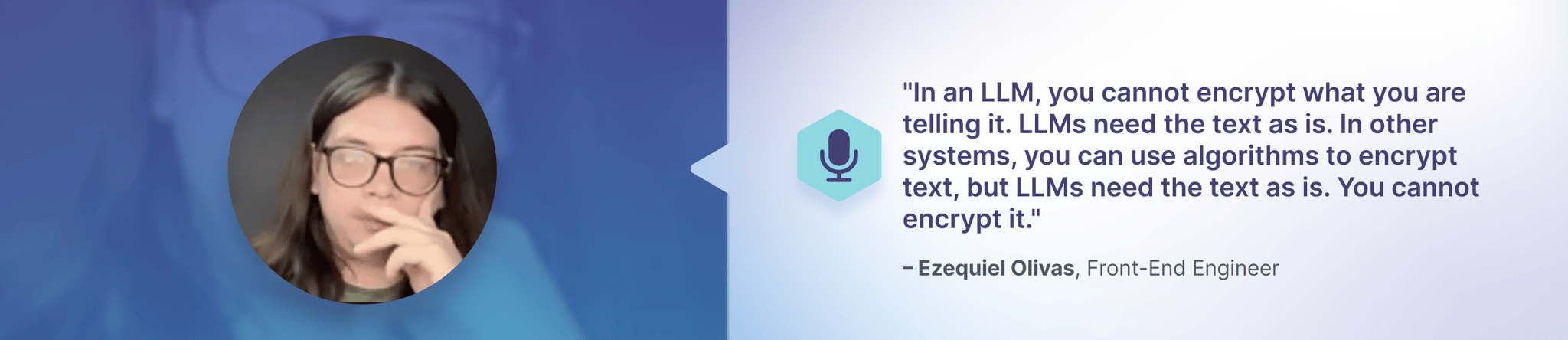
As I explained on our last webinar on the topic, the core issue is that "in an LLM, you cannot encrypt what you are telling it. In other systems, you can use algorithms to encrypt text, but LLMs need the text as is. You cannot encrypt it."
This isn't a limitation that will be fixed in the next model release. It's fundamental to how language models work. The AI needs to understand your prompt to generate a response. Understanding requires access to the actual content, not encrypted gibberish.
When you send a prompt to ChatGPT, Claude, or Gemini, you're sending plain text to servers you don't control. Your carefully constructed security perimeter doesn't extend to those servers. Your encryption keys don't protect data once it leaves your environment and enters theirs.
For enterprises handling sensitive client information, this creates an immediate problem. The productivity benefits of AI come with a data exposure risk that traditional security frameworks weren't designed to address.
Client Data Exposure Risks When Using External AI Services
The exposure risk isn't theoretical. Every prompt containing client data represents potential leakage.
Consider what developers routinely paste into AI tools: code snippets containing API keys, database queries with real customer identifiers, configuration files with credentials, error logs containing user information, and client requirements documents with business-sensitive details.
As front-end engineers, we handle sensitive data because we are the entry point. We have forms where users enter their passwords and data. We cannot leak data from clients.
The data you send to external AI services doesn't just disappear after generating a response.
Depending on the provider and your agreement with them, that data might be stored for service improvement, used to train future models, accessible to the provider's employees, or subject to different legal jurisdictions than your own data.
Even with providers who commit to not training on your data, you're trusting their security practices, their employee access controls, their compliance with their own policies. A data breach at an AI provider could expose prompts containing your client information.
The exposure compounds when you consider how casually teams use these tools. A developer debugging a production issue might paste actual customer data without thinking. A project manager might share confidential client communications to get help drafting a response. Each instance creates exposure that your existing security monitoring probably doesn't detect.
Developing Strict AI Usage Guidelines for Enterprise Environments
Basic guidelines aren't sufficient. The claim that enterprises just need "some basic AI policies" underestimates the risk.
Eduardo Noyer, Back-End Engineer at Octahedroid, is direct about this: "There shouldn't be basic guidelines. We need strict guidelines for how to retrieve and handle data from clients, from anyone."
Effective enterprise AI policies need to address several dimensions that basic guidelines typically miss.
Data classification for AI contexts requires defining which data categories can never enter AI prompts, which require sanitization first, and which are acceptable. This classification may differ from your existing data classification scheme because AI exposure creates different risks than traditional data handling.
Prompt hygiene practices mean establishing clear rules about sanitizing data before AI interaction. This includes using mock data instead of real client information, removing identifying details from code snippets, and never including credentials or secrets in prompts, regardless of how convenient it might be.
Provider evaluation criteria should go beyond feature comparisons to assess the security and privacy posture of AI providers you're considering. This means examining their data handling commitments, training policies, breach notification procedures, and compliance certifications.
Monitoring and audit capabilities require implementing ways to detect policy violations. This might include endpoint monitoring for AI tool usage, prompt logging where legally appropriate, and regular audits of how teams are actually using AI tools versus how policy says they should.
Incident response procedures need to define what happens when someone does paste sensitive data into an AI tool. Who gets notified? What documentation is required? What remediation steps apply?
The goal isn't to prevent AI usage entirely. It's to create clear boundaries that let teams capture productivity benefits while maintaining the data protection standards your clients expect and regulations require.

Self-Hosting vs. External Services for AI Use
One response to external AI security concerns is self-hosting. Run your own models on your own infrastructure, and the data never leaves your environment.
This approach has real appeal for security-conscious enterprises. Your prompts stay on servers you control. No external provider sees your data. No training on your information by third parties.
But self-hosting introduces its own complications.
There’s an often-overlooked issue: even if you are self-hosting your model, there is a file system with what you're saying in plain text.
Self-hosted doesn't automatically mean secure.
The prompts and responses still exist as data that needs protection. Your internal security practices, access controls, and monitoring apply, but you're also now responsible for securing AI infrastructure you may not have deep expertise in.
The practical trade-offs include capability gaps, since self-hosted models typically lag behind frontier models from major providers in terms of capability. Infrastructure costs add up because running capable models requires significant compute resources. Operational expertise becomes necessary as maintaining AI infrastructure requires skills your team may not have. Update cycles mean you're responsible for keeping models current, patching vulnerabilities, and managing upgrades.
For most enterprises, the realistic choice is about finding the right balance: using external services with appropriate controls for less sensitive work, potentially self-hosting for specific high-sensitivity use cases, and maintaining clear policies about what goes where.
The AI Opt-Out Problem
But even with strong internal policies, enterprises face a broader challenge: their data may already be in training sets.
Eduardo raises this concern: "For us developers, they train on a bunch of projects and code on GitHub. That's something that's not easy to opt out of."
Code repositories, public documents, and online communications have all fed into AI training data. The question of whether you can meaningfully opt out of AI training when your data is already captured remains unresolved.
This doesn't excuse lax current practices, but it does suggest that perfect data isolation may be impossible.
The practical focus should be on controlling what you can: current AI tool usage, future data exposure, and clear policies for handling sensitive information going forward.
One final consideration: the human element in AI security often gets overlooked.
People interact with AI tools differently than other software. The conversational interface encourages sharing. Users sometimes treat AI assistants like confidants, revealing personal information, business concerns, and sensitive details they would never put in an email or document.
AI company executives have publicly warned users not to share information they want to keep private. Yet the design of these tools, the conversational tone, the helpful responses, all encourage exactly that kind of sharing.
What This Means for Enterprise AI Strategy
Enterprise policies need to account for this psychological dimension. Training should emphasize not just the technical risks but the tendency to over-share with AI tools. The friendly interface doesn't change the underlying reality: you're sending plain text to external servers.
The security blind spots in enterprise AI usage aren't insurmountable, but they require deliberate attention:
- Start by auditing current AI tool usage across your organization. You may be surprised by how widespread adoption already is and how little oversight exists. Understand what data is flowing to external services before trying to control it.
- Develop policies that acknowledge the fundamental encryption limitation. Traditional security assumptions don't apply. Your AI guidelines need to start from the premise that anything sent to an external AI service should be treated as potentially exposed.
- Evaluate the true cost of secure AI implementation. The subscription price is just the beginning. Factor in compliance overhead, monitoring requirements, and the operational burden of maintaining appropriate controls.
- Consider your data sensitivity profile when choosing between external services and self-hosting. There's no universal right answer, but there is a right answer for your specific risk tolerance and capability requirements.
- Train your teams on AI security, not just AI productivity. The convenience benefits are obvious and well-marketed. The security implications need equal attention.
Contact us for a consultation to evaluate your current AI security posture and develop guidelines appropriate for your enterprise environment and risk profile.

About the author
Related posts
AI vs. Automation: What’s the Difference and How to Choose the Right Layer
By David Cespedes, July 10, 2026What is the difference between AI and automation, and how do you decide which layer belongs where? Here’s our practitioner’s decision framework from enterprise pipeline implementations.
What Is Business Process Automation and How to Define What to Automate First
By David Cespedes, June 16, 2026Business process automation works when you define the right processes first. We discuss how to identify automation candidates and avoid the most common failure modes from our enterprise experience.
Take your project to the next level!
Let us bring innovation and success to your project with the latest technologies.