The Enterprise Decision Framework: When to Migrate from Static Site Generators
Should enterprises abandon their static site generators in favor of newer frameworks?
Modern frameworks offer compelling capabilities, and many organizations can achieve their goals through strategic optimization rather than full migration.
At Octahedroid, we've guided enterprise teams through this decision over the past several years, working with organizations running everything from small marketing sites to massive multi-language platforms.
The patterns are clear: migration isn't always necessary, but when it is, the approach matters tremendously.
Here's what you need to know.
The Static Site Generator Legacy Challenge
Enterprises that adopted static site generators five to eight years ago made a sound technical decision at the time.
SSGs offered an irresistible value proposition: pre-render everything, serve static files from a CDN, eliminate runtime complexity, and achieve near-instant performance with minimal operational overhead.
Carlos Dinarte explained the original appeal in our webinar on the topic: "If you generate static files, you can place them pretty much anywhere. You can have an S3 bucket and just expose that as a site, and it will work."
That simplicity, security, and reliability drove widespread adoption, particularly for content-heavy sites where pages don't change minute-to-minute.
This challenge becomes even more complex when you consider what truly scalable architecture requires.
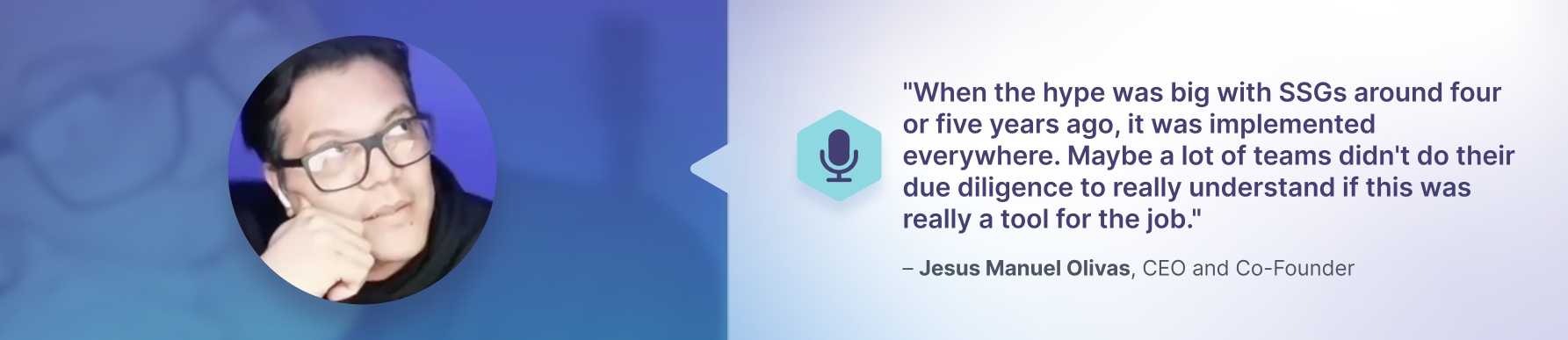
As Jesus points out, "Because the hype was so big around tools like Gatsby and Next, they were the big shiny thing. A lot of teams implemented them and now they're fighting or struggling with the tool because maybe they were not the best use case."
The problem with early SSG implementations is that they often prioritized immediate performance gains over long-term architectural considerations.
You can technically achieve excellent Core Web Vitals scores and still create an unsustainable development environment as your site scales.
How Enterprise Needs Outgrow Static Site Generators
Static site generators face predictable scaling challenges that affect both technical teams and business operations. Understanding these patterns helps determine whether your organization needs migration or optimization.
For enterprises, the most common pain points involve build time escalation, content coupling complexity, and the growing need for dynamic functionality that SSGs weren't designed to handle.
Here are the primary areas where SSGs struggle at enterprise scale.
Build Time Escalation Without Remediation Options
The most immediately apparent issue is build time growth.
What once took minutes now stretches to 30 or 40 minutes, or longer for large, multi-language sites. Even modest content changes trigger full rebuilds, creating deployment bottlenecks that slow development velocity.
The key is understanding where build time optimization delivers value and where it merely delays the inevitable. Splitting builds, implementing incremental regeneration, and optimizing asset processing offer tactical gains, though organizations eventually hit the architectural ceiling these strategies can't raise.
Content Coupling and Cascading Rebuild Complexity
One of the most sophisticated challenges in enterprise SSG implementations is content interdependency. Traditional build tools struggle with the complex relationships between pages, shared components, and global data structures.
Highly interconnected pages create particular challenges. When changing one piece of content requires reflecting that change across multiple pages within the site, the complexity multiplies rapidly.
This coupling creates cascading rebuilds where updating a single global component forces hundreds or thousands of pages to regenerate. The blast radius of simple changes becomes unpredictable and expensive.
Image Processing and Asset Management Bottlenecks
Beyond build time, image processing represents a significant operational burden. Many SSG pipelines regenerate every image variant on every build, compounding delays as media libraries grow.
Image processing is very intensive. These tools generate multiple sizes, maybe even different formats for each size, and by default, they run on every single build.
The recommended solution involves upstream processing by letting your CMS or external services handle image transformations before the build. Allowing your CMS to preprocess images or integrate with external services like Cloudinary or Cloudflare means the CMS provides URLs to those external services as content, rather than raw images requiring build-time processing.
This approach reduces build overhead but adds architectural complexity and potential new dependencies.
Dynamic Feature Requirements and Hybrid Architectures
Static sites were never designed to remain static forever. As business requirements evolve, organizations need personalization, real-time data, user-generated content, and interactive features that strain SSG capabilities.
While static sites can incorporate dynamic interaction through serverless functions, weaving serverless endpoints, API routes, and hybrid rendering into an SSG architecture introduces complexity that can undermine the simplicity that made SSGs attractive initially. Teams find themselves maintaining increasingly fragile workarounds.
Tool Maturity and Community Investment
Some popular SSGs are being deprecated or experiencing reduced community investment. Maintaining custom patches, working around framework limitations, or dealing with breaking changes in major version updates creates ongoing technical debt.
This isn't necessarily a crisis, but it's a factor in the total cost of ownership calculation that organizations must consider.
Enterprise SSG Assessment Framework
Our decision framework for static site generator evaluation reflects years of experience helping organizations navigate this choice. The assessment reflects context and risk awareness, aligning decisions with business priorities.
Critical Assessment Dimensions
Before considering migration, enterprises should evaluate their situation across six key dimensions:
- Team Expertise and Learning Capacity: Consider your team's experience with target frameworks like Next.js, Astro, or React Router. Evaluate the realistic ramp time for new technologies and whether your team can absorb that learning curve without disrupting other priorities.
- Risk Tolerance and Stakeholder Alignment: Evaluate your organization's capacity to absorb short-term instability during migration and establish clear rollback procedures before they become necessary. Executive support matters because it evaporates quickly when launches slip or unexpected issues emerge.
- Scale and Growth Trajectory: Today, it’s important to know how many pages your site currently has and to project how that number might grow over the next two years. Consider also how many languages, locales, and content types you manage. A website with 500 pages faces fundamentally different challenges from one with 20,000.
- Content Architecture and Coupling: Assess whether your pages are highly interconnected and whether changing one element ripples through many others. High coupling amplifies migration complexity and increases the probability of breaking changes in unexpected places.
- Update Frequency and Dynamic Requirements: Consider how often your content changes and whether you need real-time features, personalization, or user-generated content. Static Site Generators (SSGs) perform exceptionally well with stable content, but they struggle to keep up with highly dynamic requirements.
- Hidden Operational Costs: What's the true cost of maintaining your current SSG? Factor in developer frustration, workaround complexity, missed opportunities, and the growing risk of tool obsolescence.
If multiple dimensions point toward sustained pain, high coupling, frequent updates, and team capability gaps, migration gains strategic weight.
Conversely, stable sites with capable teams and manageable content may find that optimization delivers acceptable results.
Edge Case Analysis: Where Complexity Hides
Migration decisions succeed or fail based on edge cases, those rare but high-impact scenarios that polished demos conveniently ignore.
Jesus warns explicitly about this trap: "You need to analyze and understand your edge cases. I can think about having gazillions of images, a lot of pages to build, or maybe pages that are all interconnected."
These challenges become even more pronounced when dealing with content volume and internationalization.
Content volume and internationalization introduce significant scalability challenges. Sites mirrored across multiple languages with thousands of pages per locale don’t scale linearly. As the number of pages grows, build times and complexity increase exponentially, often leading to longer deployment cycles and reduced flexibility.
Dependency graph coupling further amplifies these challenges. When content models include pages that reference shared data structures, every rebuild cascades through the entire system. What works efficiently at a smaller scale, for example, 100 pages, can become unmanageable when multiplied by hundreds or thousands.
Global components and shared templates add another layer of complexity. In theory, updating a single element, such as a shared footer, should be simple. In practice, tightly coupled static site generator (SSG) architectures often trigger full rebuilds, consuming unnecessary resources and extending delivery times.
Media-heavy content also puts pressure on the build process. A single product page containing dozens of high-resolution images can take longer to generate than a hundred text-based pages combined, especially when image transformations occur at build time. This not only affects performance but can also impact team productivity and iteration speed.
Custom Assessment Architecture
Our evaluation approach balances multiple factors:
- Automated Baseline Scanning: Rapid identification of technical constraints and bottlenecks.
- Edge Case Analysis: Deep evaluation of complexity patterns specific to your implementation.
- Team Capability Assessment: Honest evaluation of learning curves and operational readiness.
- Strategic Planning: Comprehensive roadmap with clear decision points and rollback options.
This approach ensures organizations make decisions based on actual constraints rather than vendor promises or framework hype.

Cost-Benefit Analysis Framework: Migration vs. Optimization
Determining whether to migrate or optimize requires quantifying both visible and hidden costs against expected benefits. This framework helps organizations make data-driven decisions rather than emotional ones.
Migration Costs
Direct expenses add up quickly: development time for replatforming, new tooling and infrastructure, training on unfamiliar frameworks, running parallel systems during transition, and comprehensive testing. Migration work also consumes bandwidth that could otherwise drive new capabilities.
Hidden costs matter just as much. Teams experience reduced velocity for three to six months while adapting to new technologies. Unexpected issues requiring emergency fixes happen more often than anticipated. Features not built during migration represent real opportunity costs. Bugs or performance issues during transition can damage customer relationships, while prolonged migration work affects team morale and retention.
The benefits include reduced build times, improved developer velocity, and capabilities for dynamic features that SSGs struggle to deliver. Modern tooling lowers future maintenance costs, and updated technology helps attract and retain top talent.
Optimization Costs
The primary expenses involve engineering time for performance improvements, architectural refactoring to reduce coupling, and infrastructure upgrades like CDN enhancements or specialized image processing tools. Ongoing workaround maintenance accumulates technical debt over time.
Hidden costs include missed opportunities for dynamic features, slower iteration cycles creating competitive disadvantage, and technical debt that eventually forces migration anyway.
The benefits are meaningful: incremental performance gains with lower risk, preserved team knowledge, continued operation without disruption, lower immediate investment, and flexibility to defer migration while gathering data.
When Numbers Don't Tell the Full Story
Some factors resist quantification but matter significantly: strategic alignment with long-term technology direction, team morale and developer satisfaction, competitive positioning requiring capabilities SSGs can't deliver, regulatory or compliance requirements favoring certain architectures, and vendor viability with community support.
These qualitative factors can tip decisions even when pure cost analysis suggests otherwise.
Future Implications for Static Site Architecture
The evolution of static site generators and JAMstack architectures marks a fundamental shift in how enterprises approach content delivery, developer experience, and operational efficiency.
Hybrid Architectures and New Paradigms
As enterprise requirements evolve, pure static generation becomes less common than hybrid approaches. Organizations increasingly need:
- Static generation for stable, content-heavy pages that don't change frequently.
- Server-side rendering for personalized content or frequently updated sections.
- Edge computing for dynamic functionality without traditional backend infrastructure.
- Incremental regeneration that updates only what actually changed.
This evolution reflects changing business needs, particularly among enterprises balancing performance requirements with operational complexity and dynamic feature demands.
Framework Maturity and Enterprise Adoption
Future framework selection will likely prioritize:
- Stability and long-term support over cutting-edge features.
- Migration paths that minimize risk and disruption.
- Hybrid rendering strategies that adapt to different content types.
- Developer experience balanced with operational requirements.
Carlos offers a perspective on framework choice: "Everything evolves pretty fast, so be sure to keep updated with the latest technology. But keep a cool head. Doing something right now doesn't mean you need to do something else the next month. At the end of the day, we use technology for an objective: to serve a need. As long as we do that at a certain level of efficiency, the tool is just a tool."
Integration with Modern Development Workflows
Static site architecture is becoming increasingly integrated into standard enterprise development practices through:
- CI/CD pipelines that handle complex build and deployment logic.
- Preview environments for content team validation before production.
- Automated testing that validates accessibility, performance, and functionality.
- Monitoring and observability that tracks real user experience metrics.
The Path Forward for Enterprise Static Sites
The evolution of static site generators and JAMstack signals a broader transformation in how enterprises deliver content and manage development workflows.
Modern framework capabilities represent a different approach to content delivery, developer experience, and operational efficiency
Jesus reinforces the pragmatic approach: "Don't follow the hype. Make sure you make the right decisions. Maybe staying with the static site is the best option at this very moment. Do the right planning. Taking this slowly and making sure you take the right decision is way better."
By combining strategic assessment with incremental implementation, organizations can evolve their architecture without catastrophic risk. The result is: sustainable digital platforms that serve business needs effectively while remaining maintainable by real teams.
As the web continues to evolve with new rendering strategies and user expectations, thoughtful architecture planning provides the foundation for adapting to these changes while maintaining focus on actual business value and operational efficiency.
Thoughtfully selecting and implementing approaches that align with your organization's specific needs, constraints, and capabilities is the future of enterprise web architecture
Contact us for a free consultation to evaluate your static site generator setup and explore optimization or migration strategies tailored to your specific organizational needs.

About the author
Related posts
AI vs. Automation: What’s the Difference and How to Choose the Right Layer
By David Cespedes, July 10, 2026What is the difference between AI and automation, and how do you decide which layer belongs where? Here’s our practitioner’s decision framework from enterprise pipeline implementations.
What Is Business Process Automation and How to Define What to Automate First
By David Cespedes, June 16, 2026Business process automation works when you define the right processes first. We discuss how to identify automation candidates and avoid the most common failure modes from our enterprise experience.
Take your project to the next level!
Let us bring innovation and success to your project with the latest technologies.